
Hardcover Casing-In Production Line
This is the step where the prepared book block becomes a finished hardcover book. The line reinforces the spine, feeds the case, lifts the book block into position, and presses everything together.
Key moments
| 00:00 | Bare book block ready for casing-in |
| 00:52 | Camera-guided alignment |
| 01:24 | Spine glue application |
| 01:35 | Mull cloth reinforcement |
| 02:20 | Spine lining paper |
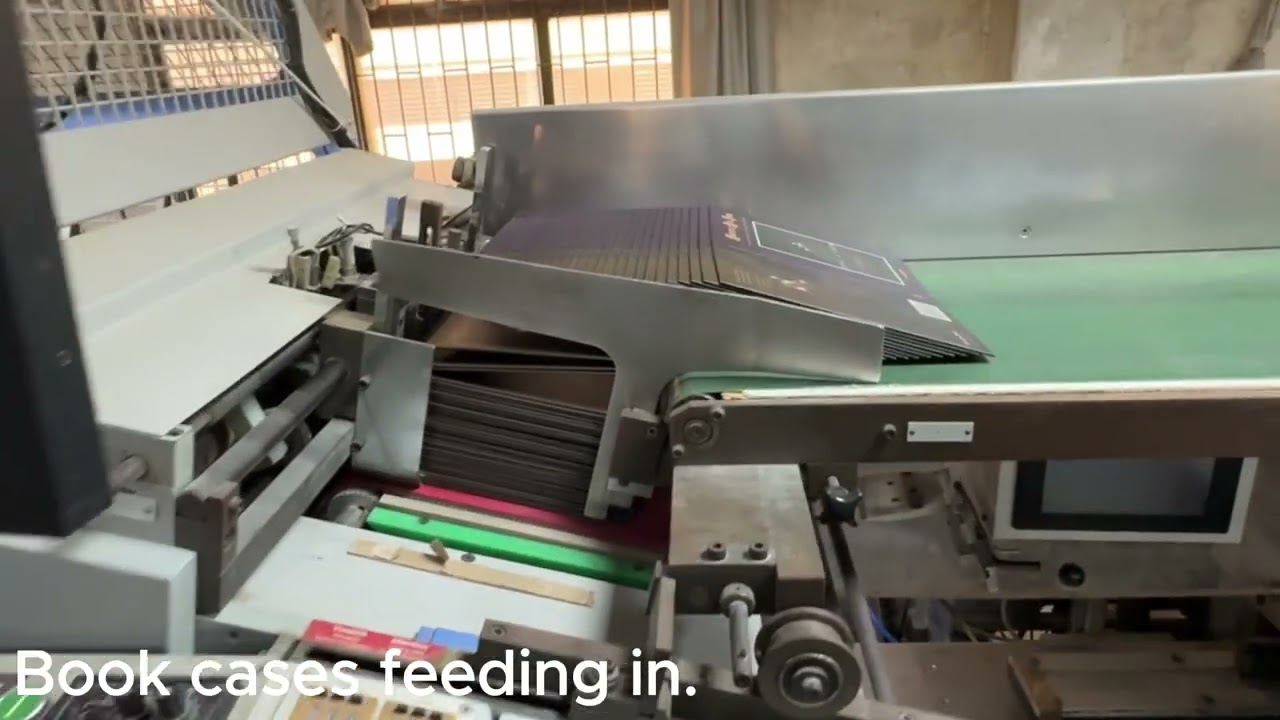
| 03:03 | Hardcover cases feeding in |
| 04:08 | Book block lifted into the case |
| 04:48 | Final pressing |
What is casing-in, and why is it the moment a book becomes a hardcover?
Casing-in is the step where the finished book block is joined to the hard cover case. Before this point, the interior pages may already be printed, folded, gathered, sewn, trimmed, glued, and reinforced, but it is still only a book block.
In the video, you are watching that book block become a casebound hardcover. The machine brings together two separate parts: the prepared interior and the rigid cover case. This is why hardcover production has more structure than a simple softcover job.
Why does the spine get reinforced before the cover goes on?
The spine is where most of the stress goes when a hardcover is opened, closed, shelved, shipped, and read over time. That is why the line applies glue, mull cloth, and spine lining before the book block is placed into the case.
Mull cloth, also called gauze or super, helps connect the book block to the case while still allowing the spine to open properly. The goal is not just to make the book look finished on day one. It is to keep the hinge strong after repeated use.
Why does alignment matter so much on a hardcover book?
A hardcover case is slightly larger than the trimmed pages. That overhang needs to be even at the head, tail, and fore edge. If the book block is off-center, the cover can look crooked, the spine title can feel misregistered, or the hinge can open unevenly.
This is especially important for art books, photography books, children's hardcovers, and any book with precise cover design. Casing-in is one of the places where good equipment and careful setup protect the final appearance of the book.
Why does pressing happen after the book block goes into the case?
After the book block is attached to the hardcover case, the book still needs pressure. Pressing helps the glued areas make full contact, sets the hinge shape, and keeps the cover from drying with waves, air pockets, or uneven tension.
This step matters because glue alone does not create a clean hardcover. The book has to dry under control. If pressing is weak or uneven, the finished book can have loose endpapers, a soft hinge, poor spine shape, or covers that do not close cleanly.
In the video, the final pressing step is easy to miss, but it is one of the reasons the book comes off the line looking like a finished hardcover instead of just a covered book block.