
Spot UV Cover Finish Production Video
This video shows the Spot UV finishing step for a printed book cover. A clear gloss coating is applied only to selected design areas, so those details catch light against the surrounding matte or laminated surface.
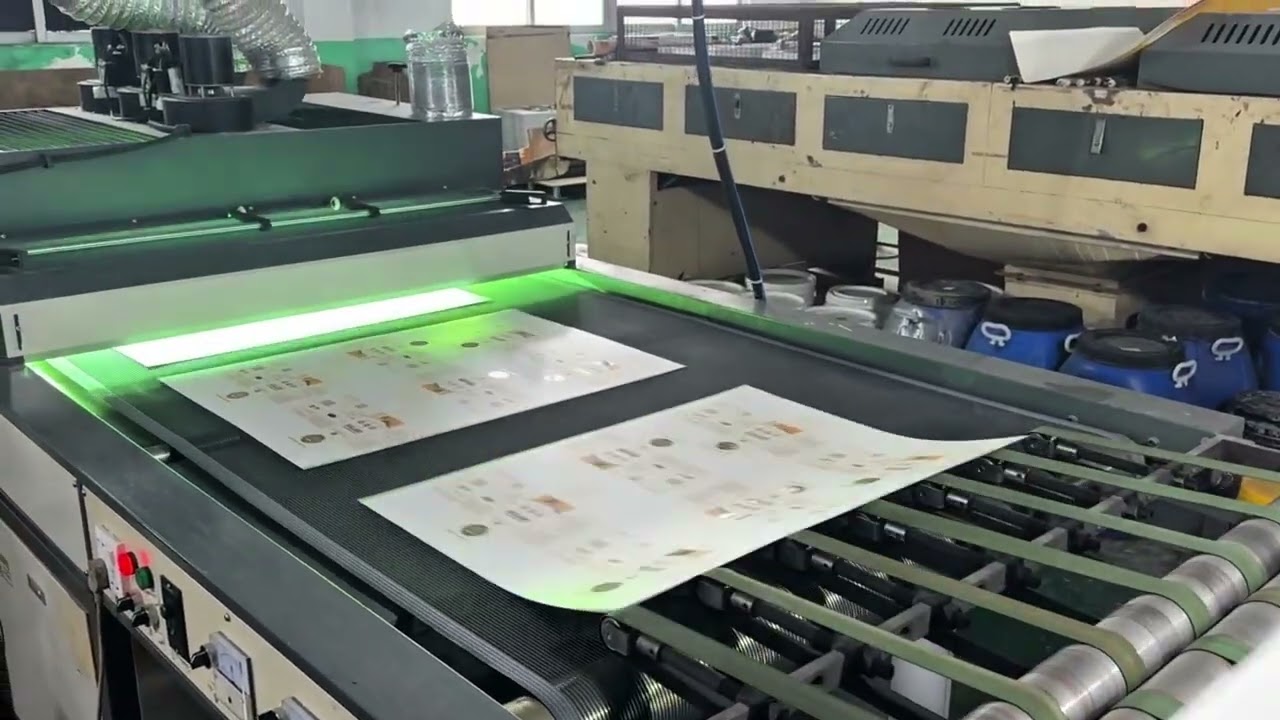
Key moments
| 00:00 | Stacked sheets are fed onto the belt one by one by the suction arm |
| 00:05 | The blade scrapes UV liquid across the screen and applies it to the selected areas |
| 00:14 | The sheet moves under UV light so the coating can harden |
| 00:22 | The finished stack is collected at the end, ready for the next step |
How do we make sure the Spot UV lands in the right place?
Spot UV is not applied by guessing. We use a separate Spot UV file that shows exactly where the clear gloss coating should go. That file is matched to the printed cover artwork during production.
Small movement can still happen because each sheet is being fed through a machine. That is why very thin lines, tiny text, or UV areas that must line up perfectly can be risky. Spot UV works best when the design gives the gloss area a little room to land cleanly.
Why does Spot UV look better on a matte cover?
Spot UV is glossy, so it needs contrast to be seen clearly. On a matte laminated cover, the glossy areas catch the light and stand out more.
On a glossy cover, the effect is weaker because the whole surface already reflects light. The Spot UV is still there, but it will not look as strong. If you want to compare the feel in person, our sample pack includes different cover finishes.
What is happening when the machine applies the UV coating?
The machine uses a screen, which works like a stencil. The clear UV coating only passes through the open areas of that screen.
A blade pushes the coating across the screen, and the coating transfers onto the selected parts of the cover sheet. That is how only the title, logo, pattern, or artwork detail gets the glossy finish instead of the whole cover.
What artwork works best for Spot UV?
Spot UV works well on bold titles, logos, simple shapes, patterns, and design details that are large enough to hold cleanly in production.
It is less reliable on very small type, thin strokes, tiny dots, or areas that need perfect edge-to-edge alignment with printed artwork. Before sending files, the Spot UV setup guide is the best place to check how the UV layer should be prepared.
Why does the sheet go under UV light after coating?
After the clear coating is applied, it needs to harden. The UV light cures the coating quickly so it becomes glossy, dry, and more durable.
This curing step matters. If the coating is not cured properly, the gloss may not look clean, the surface can feel tacky, or the finish may not hold up well during later steps like trimming, binding, packing, and shipping. For a thicker effect that can be felt by touch, see the difference between Spot UV and Raised UV.